What pressure should my RV tires be?
Start with the tire's full identity and your loaded wheel-position weights. For a supported motorhome tire, the lookup selects the first published pressure that carries the heavier end of the axle. It keeps an entered manufacturer requirement as a floor and checks the pressure limits you supply. Every tire on that axle uses the same setting. A front axle and a rear axle can need different pressures.
The Michelin RV tables distinguish single and dual installations and require matching sidewall markings. The tire size alone is insufficient. In this tool, the menu includes the manufacturer, tire line and load range; the saved details above it help you find that match. If your tire is absent, use its maker's chart or dealer. Selecting the closest-looking entry is not a supported substitute.
Check one axle at a time. Keep the tire arrangement and the weights together when you switch between axles. The copy link remembers that calculation; the printed record has space for an axle name and weigh date. Your saved rig supplies tire details, while trying another table or load leaves those details alone.
Should travel trailer tires run at maximum cold psi?
Follow the instruction for your trailer and installed tires. Carlisle's published advice specifies the maximum pressure recommended on the sidewall, checked cold, and rejects adding pressure to permit higher speeds. That is a manufacturer instruction, not a universal formula derived from the letters ST. A lighter measured load does not by itself authorize lowering a prescribed pressure.
Goodyear publishes load/inflation rows for Endurance ST tires. Here they answer a capacity question: which listed pressure supports the measured load? The required-pressure field answers the separate operating question. Until you supply that requirement, the result shows a table minimum with no setting calculated. If a requirement is lower than the load needs, the higher table minimum applies, subject to the equipment limits.
| Heavier end | Table minimum | With an 80 psi instruction | Margin at setting |
|---|---|---|---|
| 1,800 lb | 40 psi | 80 psi | 1,030 lb |
| 2,200 lb | 55 psi | 80 psi | 630 lb |
| 2,500 lb | 65 psi | 80 psi | 330 lb |
| 2,800 lb | 80 psi | 80 psi | 30 lb |
| 2,900 lb | Overloaded | No setting | -70 lb |
Engine lookup: Goodyear Endurance ST225/75R15 E, single tires, an assumed 80 psi maker instruction and 80 psi wheel limit. Loads are example heavier ends; the source is Goodyear's 2017 chart copy, not a current fitment recommendation.
Can I use a CAT scale ticket to set tire pressure?
A normal ticket is useful for axle and gross weights, but it does not tell you which end is heavier. CAT Scale explicitly says it cannot provide corner weights and does not allow individual-wheel weighing on its scales. A trailer platform can also carry several axles together. Dividing that platform total by the number of tires loses both the front-to-back and side-to-side differences.
Use the CAT Scale Ticket Reader for the weigh passes, hitch load and rating checks. For this lookup, arrange individual wheel-position weighing with suitable equipment and a trained operator, loaded as you travel. In “Only the whole axle's weight” mode, the tool reports an average but withholds a pressure. A total above the tires' combined capacity can prove overload; a total below it cannot clear each tire.
Michelin's weighing bulletin explains why wheel positions matter even when an axle is inside GAWR. Cabinets, tanks and equipment need not divide evenly between sides. The heavier measured end sets the pressure across that axle. More air cannot fix a load above the tire's maximum rating.
How do I read the single and dual columns?
A single installation has one tire at each end. A dual installation has two beside each other at each end. In the Michelin RV charts used here, the dual value covers the pair at one end. Enter that pair's combined weight. Do not divide it by two before using this tool. Other charts may publish per-tire or whole-axle loads, so check their headings before copying a number.
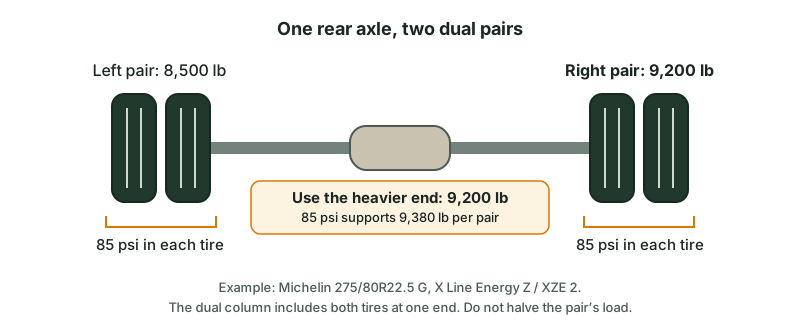
The Michelin guide's example has front weights of 5,400 and 5,175 lb. The heavier end needs 95 psi. Its rear dual pairs weigh 8,500 and 9,200 lb; the rear needs 85 psi. The printed capacities and the engine agree:
| Axle | Heavier end | Previous row | First row that carries it |
|---|---|---|---|
| Front, single | 5,400 lb | 90 psi: 5,370 lb | 95 psi: 5,510 lb |
| Rear, dual pair | 9,200 lb | 80 psi: 9,080 lb | 85 psi: 9,380 lb |
Engine results, Michelin 275/80R22.5 G X Line Energy Z / XZE 2. Pounds per axle end; no additional manufacturer pressure floor in this example.
The front totals 10,575 lb and the rear 17,700 lb. The rear's load is supported by four tires. Its table minimum is 85 psi, compared with 95 at the front. Comparing whole-axle weights without the tire arrangement would miss that result.
What if the placard, sidewall and table disagree?
Record what each number describes. The placard gives a vehicle-maker recommendation. A sidewall states a tire load and associated pressure. A load table describes capacity at listed pressures for a particular tire and installation. NHTSA's tire guidance directs owners to the vehicle placard or owner's manual for recommended cold pressure. Locate those labels with the RV numbers guide.
If tires or wheels have changed, have the vehicle or tire maker reconcile the specifications. Enter the applicable instruction in “Required cold pressure.” This tool will not reduce that number just because the present load is light. A requirement above an entered wheel limit produces no setting; it does not silently clamp the answer to a lower pressure.
The included charts are deliberately limited to the verified entries in the menu. Goodyear's original RV PDF address now redirects, so its manufacturer document is linked through a preserved copy. Michelin's current LT225/75R16 link serves a different C-metric chart; that size is excluded here. Confirm current markings and instructions before relying on an older chart.
Should I add extra psi above the table minimum?
RVSEF suggests a reserve above the minimum for changing travel loads, while also distinguishing the demands of towable tires. The result here makes no automatic reserve assumption. Enter a higher pressure requirement when your manufacturer or tire professional specifies one; the load table and pressure limits still apply. The load margin displayed is capacity left at the selected setting, not permission to exceed an axle or vehicle rating.
If a required setting falls between printed pressure steps, the reported capacity and margin use the lower step. No extra capacity is invented between rows. If a tire is overloaded, reduce or redistribute cargo and reweigh. Check the effect on the other positions as well. The loaded-weight calculator helps account for water, batteries and gear, while the towing checks cover the combination's other ratings. Raising pressure beyond the supported range is not a capacity upgrade.
Why does pressure rise after driving?
Tires warm during use, so a hot reading is not directly comparable with a cold setting. NHTSA defines cold for its pressure check as a vehicle that has not been driven for at least three hours. Check before travel with an accurate gauge and follow the installed tire's instructions. Do not bleed a hot tire down to its cold pressure. Michelin's maintenance guide warns that doing so leaves it underinflated after cooling.
Keep the printed chart with the axle name, weigh date and pressure record. When the travel load changes, revisit the wheel weights rather than editing the old result by feel. A pressure monitor can alert you to a change during a trip, but it does not replace a gauge check or a tire inspection.
Sources
- Load and Inflation Tables for RV Tires, Michelin: five included tables checked against the linked chart images and the May 2025 guide; RV loads are per axle end, including the dual pair
- Michelin RV Tires: Guide for Proper Use and Maintenance (May 2025), Michelin: pp. 4, 15, 27, 29: cold pressure, worked axle-end example and inflation tables
- Motorhome Weighing & Air Pressure Recommendation, Michelin: use the heavier wheel position to set one pressure across an axle; axle totals can hide a tire overload
- Goodyear Endurance ST Load/Inflation Information (2017 copy), Goodyear; copy hosted by Fifth Wheel Street: page 1, six included Endurance ST sizes; stop at the marked D/E maximum; original goodyearrvtires PDF now redirects
- Should trailer tires be over-inflated to allow faster highway speeds?, Carlisle: manufacturer instructs maximum sidewall cold pressure; no overinflation for speed
- Tire Load and Inflation Ratings, RV Safety & Education Foundation: wheel-position weighing, maker-specific charts, optional 5 psi reserve within equipment limits, and trailer-use differences
- TireWise: Tire Safety Ratings and Awareness, NHTSA: vehicle placard and owner manual pressure; cold means not driven for at least three hours
- How To Weigh, CAT Scale: motorhome axle/gross weights, no individual-wheel weighing; trailer platform can hold multiple axles